Does Red Light Therapy Help With Pain? Here's What the Research Shows
· By Dana Whitfield
If you've searched for ways to ease knee or joint pain without medication, you've probably run into red light therapy somewhere between confusing infomercials and legitimate medical research. Search interest in red light therapy for pain has grown fast, and terms like "photobiomodulation" and "infrared light therapy" now show up everywhere from physical therapy clinics to Instagram ads for wearable wraps. The starting point is that this isn't a new gimmick dressed up in LEDs. It is an actual area of clinical research, with real limitations, and the rest of this article sets out what that research measures and where it stops.
This guide walks through what peer-reviewed research on photobiomodulation actually shows about pain, what it doesn't show, how it differs from an actual laser despite the marketing language you'll sometimes see, and who is most likely to notice a difference. We'll point to the specific sources behind each claim, because at GlowKnee we'd rather show you the evidence than just ask you to trust us.
What Is Red Light Therapy, Exactly?
Red light therapy is the everyday name for what researchers call photobiomodulation: exposing skin and the tissue underneath it to specific wavelengths of red light (roughly 620 to 700 nanometers) and near-infrared light (roughly 700 to 1000 nanometers). These wavelengths sit at the edge of the visible spectrum, and they are used because they penetrate skin more effectively than most other colors of light, without generating the heat or tissue damage associated with surgical lasers.
In clinical studies, this light has been delivered through both low-level laser devices and LED panels or pads. In the at-home wellness market, nearly every wearable device, including wraps, masks, and mats, uses LED arrays rather than true lasers, since LEDs are simpler to manufacture safely at consumer power levels and don't carry the same regulatory classification as medical laser equipment.
What the Research Actually Shows
The research base is real, and it has grown substantially over the past decade. A 2022 systematic review published in the European Journal of Physical and Rehabilitation Medicine looked specifically at low-intensity laser and LED photobiomodulation therapy for pain control across the most common musculoskeletal conditions. The reviewers found evidence that photobiomodulation reduced pain intensity in non-specific knee pain, knee osteoarthritis, pain following hip replacement surgery, fibromyalgia, temporomandibular joint disorders, neck pain, and low back pain, and they described it as a non-invasive, drug-free option with a favorable safety profile.
That matters because joint pain is extremely common. The Centers for Disease Control and Prevention estimates that osteoarthritis, the most frequent form of arthritis, affects roughly 32.5 million adults in the United States, with the knee among the joints most often involved. It isn't surprising that so many people are searching for non-drug ways to feel more comfortable day to day.
| Condition studied | What the 2022 review reported |
|---|---|
| Knee osteoarthritis / non-specific knee pain | Reduced pain intensity reported across multiple trials |
| Low back pain | Pain reduction reported, though protocols varied widely |
| Fibromyalgia | Included among conditions showing reported benefit |
| Pain after hip replacement surgery | Used as an adjunct during post-operative recovery |
| Neck pain and TMJ disorders | Also included in the reviewed evidence base |
Source: de Sire A, et al., "Low-intensity LASER and LED (photobiomodulation therapy) for pain control of the most common musculoskeletal conditions," European Journal of Physical and Rehabilitation Medicine, 2022. Osteoarthritis prevalence: Centers for Disease Control and Prevention (CDC), 2024.
How It Is Thought to Work
The leading explanation involves mitochondria, the energy-producing structures inside cells. Red and near-infrared light is absorbed by an enzyme called cytochrome c oxidase, part of the mitochondria's energy-production chain, and researchers believe this can temporarily increase cellular energy output and influence local inflammatory signaling. Some studies also report short-term increases in local blood flow at the treated site.
It helps to know this is a different mechanism from a heating pad, which works by raising tissue temperature to relax muscle and encourage circulation. Many home devices combine a light-therapy element with a separate heat element in the same product, and while both can contribute to comfort, they work through different pathways rather than being the same feature described two ways.
What the Evidence Does Not Show
Honesty matters here as much as enthusiasm. The research on photobiomodulation is real, but it isn't uniform. Study protocols differ widely in wavelength, dose, session length, and device power, which makes it hard to say that any single at-home product will reproduce the results of any single clinical trial. Reviewers themselves note ongoing debate about the size of the effect and the quality of some of the underlying trials.
Just as important, no credible study claims that red light therapy reverses arthritis, regrows cartilage, or cures a joint condition. What the evidence supports is a reduction in reported pain intensity and improved comfort for some people, used alongside, not instead of, movement, physical therapy, and medical care. If you have a diagnosed joint condition, persistent swelling, or pain that is getting worse, red light therapy is not a substitute for seeing a doctor or physical therapist, and it should be treated as a comfort-focused addition to your routine rather than a treatment plan on its own.
Is It Actually a "Laser"?
This is a fair question, and one worth asking about any product that uses the word "laser" in its marketing. Actual medical lasers used in some clinical studies are regulated devices, typically operated by trained professionals. The vast majority of consumer red light therapy products, including knee wraps, face masks, and full-body panels, use LED arrays instead. LEDs can emit the same red and near-infrared wavelengths studied in the research, but at power levels appropriate for unsupervised home use, without the regulatory classification or safety handling requirements of a true laser.
If a product description says "laser" but the device is a plug-in or battery-powered wrap you strap on yourself at home, it is almost certainly LED technology described with looser marketing language, not an actual laser. That distinction doesn't make the light therapy less real, since the 2022 review referenced above studied laser and LED devices side by side and reported benefit from both, but it's worth knowing exactly what you're buying.
Who Might Consider It
Red light therapy tends to appeal most to people dealing with everyday joint or muscle discomfort, post-workout stiffness, or the kind of achiness that comes with being on your feet all day, who want a non-drug, low-effort addition to their routine rather than a medical treatment. It is not the right fit for anyone expecting a guaranteed fix for a diagnosed condition.
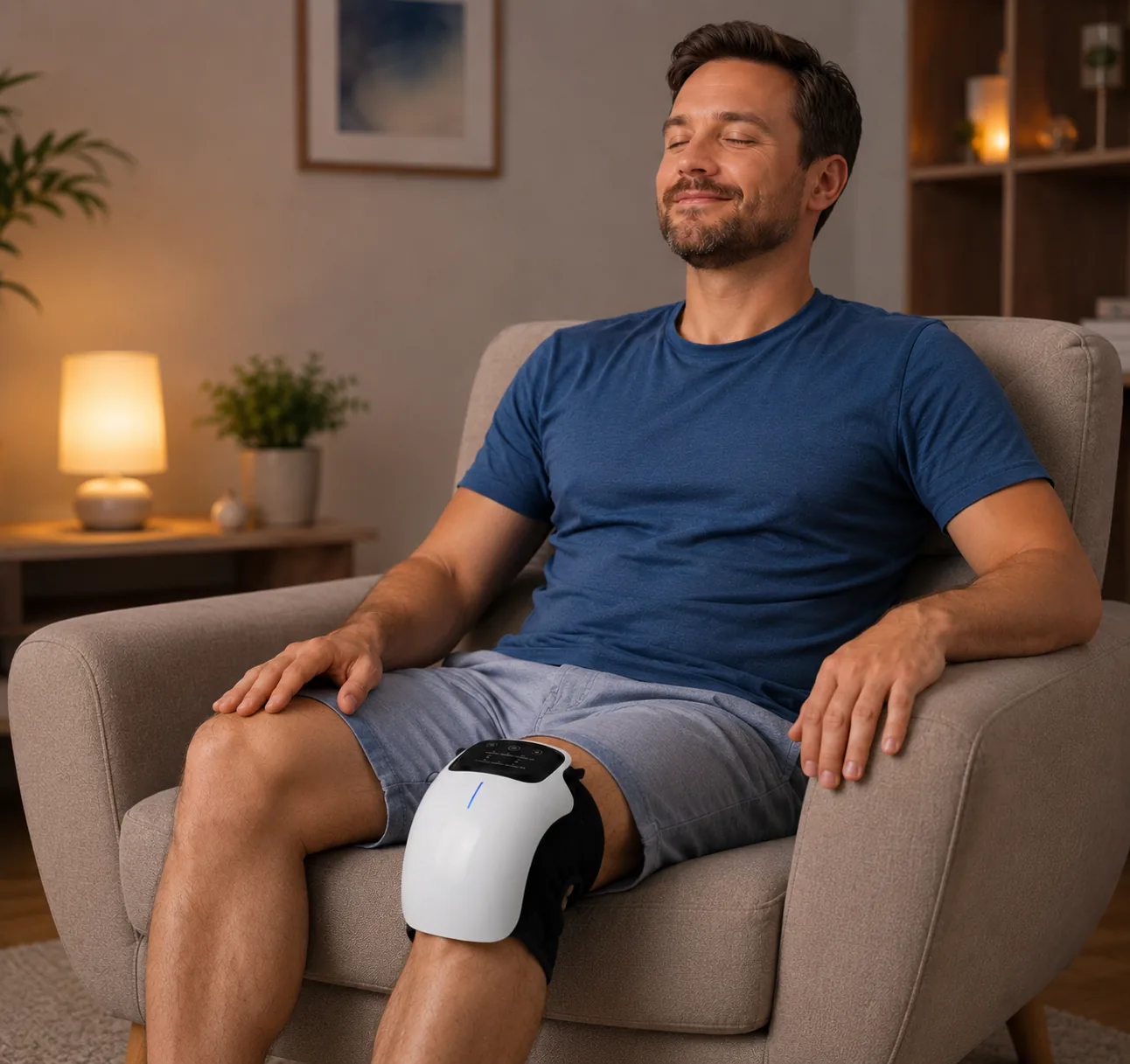
GlowKnee's knee wrap is one example of how this technology shows up in a home product: it combines LED red light and infrared light therapy with a separate heat function and adjustable vibration, wrapped around the knee joint with adjustable velcro straps in a cordless design. We break down exactly how that combination applies to knee-specific use in our full guide to red light therapy for knees, and if you're weighing how the heat function fits in, our heated knee massager page covers that piece in more depth. If your discomfort is specifically related to osteoarthritis, our guide to knee massagers for arthritis looks at that use case directly.
The Bottom Line
Does red light therapy help with pain? For a meaningful number of people and conditions studied so far, including knee pain, the answer is that the evidence points to a real, if modest, benefit, not a cure. It works best framed as a comfort and relaxation habit you keep up consistently alongside the basics, movement, rest, and professional care when something is actually wrong, rather than a stand-alone fix. For a broader look at the benefits people report with consistent use, see our guide to red light therapy benefits, or head back to the GlowKnee homepage to see how our knee wrap brings light, heat, and vibration together in one design.

Dana Whitfield · Wellness Product Tester at GlowKnee
Dana has tested dozens of at-home recovery and wellness devices, from massage tools to light therapy wraps, and writes evidence-first reviews that don't shy away from a product's limits.