
Red Light Therapy for Knee Pain: What Actually Helps at Home
· By Dana Whitfield
Knee pain rarely has one single cause. A twinge from a Saturday hike, years of stairs and squats, or the slow stiffening of a joint that has simply carried you for decades can all show up as the same nagging ache in the same spot. That overlap is part of why knee pain is one of the most common complaints doctors hear about, and one of the hardest to solve with a single fix.
Red light therapy has become one of the more talked-about at-home options for joint discomfort, but most articles about it treat every joint the same way. The knee is different. It is a large, hard-working, mostly superficial joint, which happens to make it a good candidate for light-based and heat-based home therapy. This guide looks specifically at what causes knee pain, what the research on red light therapy for the knee actually says, and how a simple at-home routine combining light, heat, and vibration realistically fits in.
What's Actually Causing That Knee Pain?
Before any home therapy makes sense, it helps to know which of three usual suspects is behind the ache: overuse, arthritis, or general aging of the joint. Most people dealing with recurring knee pain fit into one of these categories, or some overlap of two.
Overuse and Repetitive Strain
Running, cycling, gardening on your knees, or a week on a job site that has you climbing stairs all day puts repeated load through the same tendons and the same patch of cartilage. The knee does not get much of a break between reps, and the muscles around it, including the quads, hamstrings, and calves, tend to tighten up in response. This type of knee pain usually shows up after activity and eases with rest, at least at first, which is different from the pattern seen with arthritis.
Osteoarthritis and Cartilage Wear
Osteoarthritis is the gradual breakdown of the cartilage that cushions the knee joint, and it is extremely common in the United States.
U.S. adults are living with osteoarthritis, the most common form of arthritis, which most often affects the hands, hips, back, and knees
— CDC, National Health and Nutrition Examination Survey 2017–March 2020, 2020
Knee osteoarthritis specifically tends to bring morning stiffness, a grinding or catching feeling during movement, and pain that gets worse with prolonged standing or stairs. It is a structural, gradual condition, not something that develops overnight.
Age-Related Stiffness
Even without a diagnosed condition, knees behave differently as we get older. Circulation slows, connective tissue loses some elasticity, and the joint takes longer to loosen up before it moves comfortably. A long-running population study, the Johnston County Osteoarthritis Project, tracked this risk directly over time.
lifetime risk of developing symptomatic knee osteoarthritis by age 85, found in a long-term population study of US adults
— Johnston County Osteoarthritis Project, 2008
That single number is a useful reminder that knee discomfort tied to aging is closer to the norm than the exception, which is exactly why an easy, repeatable home routine matters more than a one-time fix.
How Red Light Therapy Targets Knee Discomfort
Red light therapy, sometimes called photobiomodulation, uses specific wavelengths of visible red and invisible infrared LED light aimed at the skin over a joint. The light penetrates a few millimeters into soft tissue and interacts with the mitochondria inside nearby cells, the structures responsible for producing cellular energy, which researchers believe is part of why people report feeling looser and less achy after a session.
The knee is one of the better-studied joints for this kind of therapy. A randomized controlled trial published in Lasers in Medical Science in 2025 compared photobiomodulation against a sham placebo light and a no-treatment control group in patients with knee osteoarthritis. The group receiving real light therapy showed a statistically significant reduction in pain and improved daily function scores compared with both other groups. That is a meaningfully different kind of result from most at-home wellness trends, because it comes from a controlled trial with a placebo arm, not just anecdote. For a broader look at how red light therapy performs across different types of pain beyond the knee, see our full breakdown of red light therapy and pain relief.
Heat works through a more straightforward mechanism. It increases local blood flow and helps relax the muscles bracing around a stiff or sore joint, which is why the Arthritis Foundation lists heat as one of the simplest and most widely recommended self-care tools for joint pain. Vibration adds a third layer, providing sensory input that can distract from a dull ache and helping loosen tight tissue around the kneecap before movement. None of the three replaces medical treatment for a diagnosed condition, but together they cover three different mechanisms in a single short session. If you want the settings and what a session actually feels like spelled out in more detail, our red light therapy for knees guide covers that specifically.
Matching a Home Routine to Your Type of Knee Pain
Because knee pain has more than one cause, the most useful home routine is not always the same one. The table below is a practical starting point, not a medical protocol.
| Type of Knee Pain | What's Usually Going On | Where Heat, Light, and Vibration Fit |
|---|---|---|
| Overuse or post-activity soreness | Tight muscles and tendons, mild inflammation after activity | Heat before activity to loosen tissue, then light plus vibration afterward for the ache |
| Osteoarthritis-related stiffness | Gradual cartilage wear, worse with weight-bearing | A short daily session of light and heat fits alongside a doctor's guidance as a comfort routine, not a replacement for it |
| General age-related aching | Slower circulation, stiffer connective tissue | An evening routine combining heat and gentle vibration can help the joint feel less locked up before bed |
| Standing or kneeling all day at work or in the garden | Sustained pressure and repetitive bending | A quick end-of-day session is often more about winding down than treating an injury |
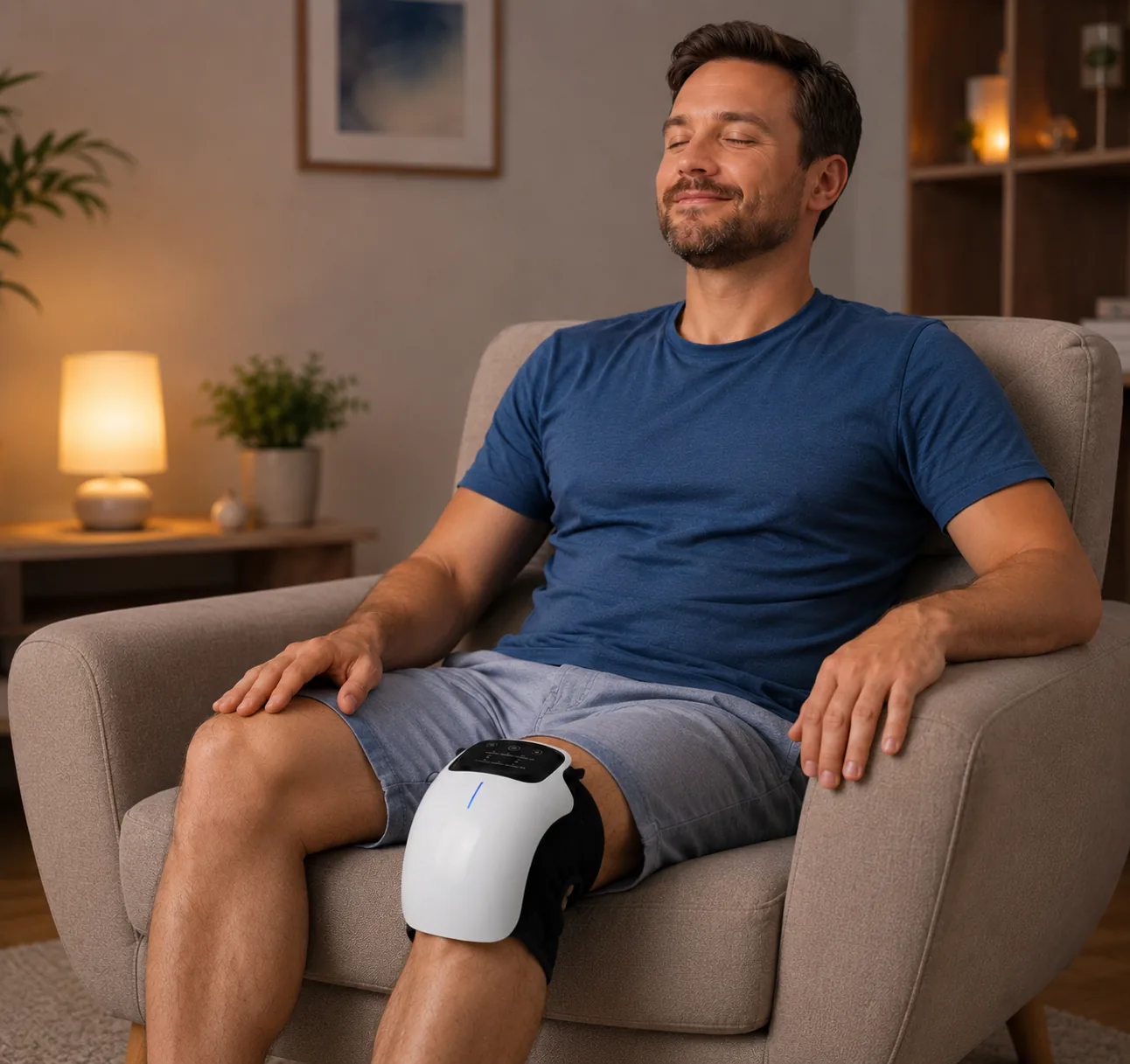
This is where a wrap built specifically for the knee has an advantage over a generic heating pad. The GlowKnee wrap combines red and infrared LED light, a heat function, and 3 levels of vibration in a single cordless design that straps around the joint with adjustable velcro, so all three go to work on the same spot at the same time instead of juggling separate tools controlled from an LED touchscreen panel. If cordless convenience matters most to you, compare the details in our cordless knee massager guide, and if heat is your main priority, our heated knee massager overview covers that function on its own.
What Red Light Therapy Realistically Won't Do
None of this is a medical treatment, and it is not a substitute for seeing a doctor or physical therapist about a new or worsening knee problem, especially if pain is sudden, severe, or follows an injury. Red light, heat, and vibration are best understood as comfort and relaxation support layered onto whatever a doctor already recommends, not a way to reverse arthritis or repair damaged cartilage. Anyone managing a specific arthritis diagnosis may also want our dedicated look at knee massagers and arthritis for more on building a day-to-day routine around it.
Because we cannot promise a specific outcome for every knee, GlowKnee backs every order with a 30-day money-back guarantee, so the risk sits with us rather than you. For a closer look at how we vet products and weigh the full review set before publishing anything, see how we test.
The bottom line: knee pain has several possible root causes, and no single tool fixes all of them. But for people dealing with overuse soreness, arthritis-related stiffness, or plain age-related aching, a short daily routine combining LED light, heat, and vibration is one of the more evidence-informed at-home options available, and it is worth trying alongside whatever care a doctor already recommends. Take a look at the GlowKnee cordless knee massager to see how light, heat, and vibration come together in a single wrap.

Dana Whitfield · Wellness Product Tester at GlowKnee
Dana has tested dozens of at-home recovery and wellness devices and writes honest, practical reviews rather than hype-driven claims.