Using a Knee Massager After Knee Replacement or Surgery: When Is It Safe?
· By Dana Whitfield
This is the most careful page on our site, and the one where we are least useful to you. We sell a heated, vibrating knee wrap. We are not clinicians and we cannot see your knee. What follows is meant to help you have a better conversation with the people who can.
Who actually decides whether it is safe?
Your surgeon, or the physical therapist running your rehab. Not this page, not a product listing, not a comment thread. That is not fine print tacked on at the bottom, it is the answer to the question in the title, which is why it sits at the top.
Dana Whitfield, who writes these guides, is a product tester. She is not a doctor, a surgeon or a physical therapist, which is stated plainly on our how we test page. A single-product store has an obvious incentive to tell you its product is fine for you, so treat any site that answers a post-surgical question with a confident yes, timeline included, as a site that is guessing.
total knee replacements performed each year in the United States, per the orthopaedic surgeons' own patient education body
— American Academy of Orthopaedic Surgeons, OrthoInfo, accessed July 2026
Why is this different after an operation?
An ordinary stiff knee and a knee that has been opened, cut and closed are two different situations wearing the same shape. On an operated knee there is a wound that may still be sealing, stitches or staples that usually come out several weeks after surgery, swelling a surgical team is actively watching, skin that often does not feel normal, and in a replacement, hardware that was not there before.
There is also a risk that has nothing to do with skin. The American Academy of Orthopaedic Surgeons describes blood clots as one of the most common complications of knee replacement surgery, and tells patients to watch for increasing calf pain, tenderness or redness near the knee, and new swelling in the leg. That is a call-your-surgeon situation, not a reach-for-a-massager situation.
What does the wrap do to an operated knee?
It helps to split the device into what it physically does, because a surgeon will not judge it as one object. The wrap applies three separate inputs to the front and sides of the joint.
The heat function warms the inside surface of the wrap against your skin. One verified buyer, Craig B., described the practical limit of that: "I used it on bare skin at a higher heat setting and it got quite hot, so now I keep a thin layer of fabric between the wrap and my skin." He was talking about a knee that had never been operated on. The vibration motor runs at one of three intensity levels, sending mechanical movement through the soft tissue around the joint. The velcro straps hold all of it in place by compressing a leg that may still be swelling.
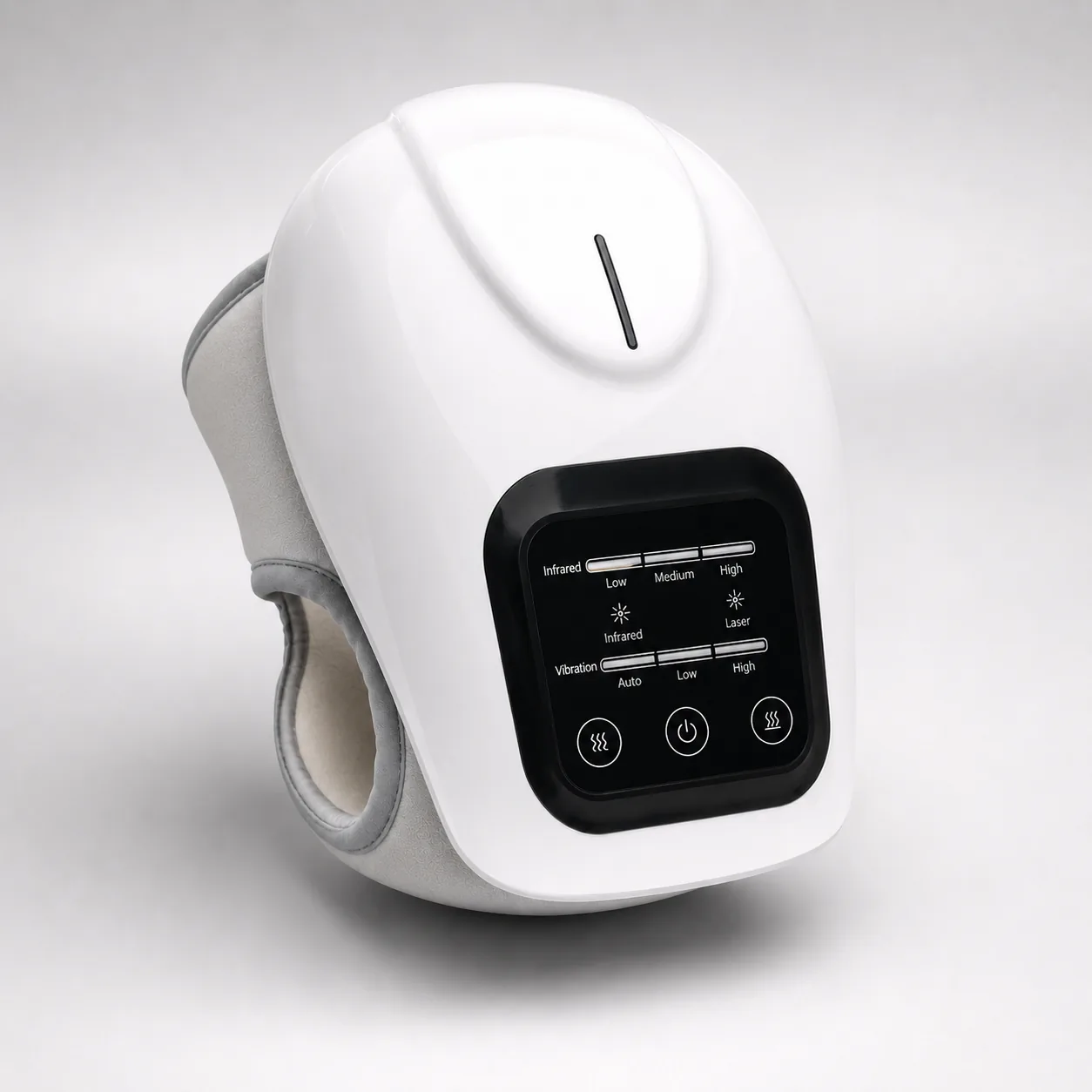
Heat, vibration and compression, over the exact patch of skin where a replacement incision usually runs. Put those three things to your surgical team rather than the brand name.
When should nothing go on that knee at all?
Some situations are not a matter of asking nicely and easing in. If any of these apply, the wrap stays in the box and the phone comes out instead.
- New or increasing calf pain or tenderness, fresh swelling in the leg, or redness near the knee. The AAOS lists these as warning signs of a blood clot after knee replacement. Call your surgeon.
- An incision that has not fully closed, still has stitches or staples in it, or is weeping, scabbed or draining.
- Spreading redness, heat, a wound opening rather than closing, or a fever. Those are infection signs and they belong to your surgical team, urgently.
- Numb or patchy skin around the scar, until your team has looked at it and told you what is safe.
- Any recent operation on that knee where you have not been cleared for heat, massage or compression, whatever the calendar says.
That is not a complete list of what can go wrong after knee surgery, only the moments when a comfort device is the wrong object to hold.
Why does numb skin around the scar matter?
Because heat injuries are prevented by feeling them coming, and after a knee replacement many people cannot. The AAOS tells patients that most people feel some numbness in the skin around their incisions. It is not a rare complication, it is close to routine, and it usually sits on the outer side of the scar.
of patients still had numbness around the knee replacement scar one year after surgery, in a prospective study
Put a heating element against skin that cannot report back and the warning that normally makes someone say this is getting too warm is simply absent. Craig B. felt his wrap getting hot and adjusted. Someone with a numb patch beside their scar may notice nothing until they look. So the advice for a healing knee is not to start low, it is to ask first, and then to check the skin with your eyes rather than trusting what you feel.
Our guide on how to use a knee massager safely covers session length, skin checks and the conditions worth raising with a doctor. An operated knee is a separate conversation.
What should you ask your surgeon?
Bring the device or a photo of it to your follow-up. Vague questions get vague answers, so ask about mechanisms rather than the product.
- Is the incision closed and settled enough for anything to sit against it?
- Are you still watching me for clot risk, and does that change your answer?
- Is surface heat over this joint fine now, and is there a limit?
- Is mechanical vibration over the joint acceptable at this stage?
- How much strap pressure is reasonable on a leg that still swells?
- Where around the scar should I not trust what I feel?
If the answer is not yet, that is a real answer and worth more than anything on this page.
If you have been cleared, what changes?
Three things, mainly. You go lower and shorter than a healthy knee would tolerate, because your margin for error is smaller. You inspect the skin after every session instead of relying on how it feels. And you stop at anything new: swelling, colour change, a sensation that was not there yesterday, or pain that behaves differently from your usual post-operative ache.
A wrap replaces nothing your physical therapist gave you. The exercises and the walking targets are the parts of recovery with real evidence behind them. People managing long-term joint pain rather than a recent operation may find our knee massager for arthritis guide closer to their situation.
What this wrap is not
The GlowKnee wrap is a $69.95 cordless comfort device with a heat function, LED red and infrared light and three vibration levels, run from a touchscreen on the shell. It is not a medical device and it has not been through independent lab testing on our side, the same standard we apply on our heated knee massager page.
It is also not the equipment surgical teams send people home with. It is not a continuous passive motion machine, not a cold therapy unit, and not a compression device for clot prevention. If your surgeon prescribed one of those, this is not a cheaper version of it. For where the evidence on the light side stops, see does red light therapy help with pain. Full spec and verified buyer reviews are on the product page.
Questions people ask before their follow-up
How long after knee replacement can I use a knee massager?
Timelines differ by procedure, by surgeon, and by how your own wound and swelling are behaving. Ask the team who performed your surgery — they are the ones who can see how you are healing.
Can I put the wrap directly over the scar?
Not while the wound is still healing, and not before your team says the skin is closed and settled. The AAOS tells knee replacement patients to avoid soaking the wound until it has thoroughly sealed and dried, and that stitches or staples come out several weeks after surgery.
Is LED red light safe over a metal knee implant?
We have no evidence either way for light used over an implanted joint, so we will not tell you it is fine. The research cited elsewhere on this site looks at knees that were never operated on. Ask the surgeon who knows what is in yours.
Can vibration or massage dislodge a blood clot?
That is a medical question and we are not qualified to answer it. What we will say is that new calf pain, tenderness, redness or fresh swelling are warning signs the AAOS tells patients to take seriously, and any of them means calling your surgeon.
Should I buy one before my operation so it is ready afterwards?
Put the question to your surgeon at your follow-up, and order once you have their answer. Delivery runs 6 to 10 business days and the $69.95 wrap carries a 30-day money-back guarantee, so you are not stuck with it if the answer at your follow-up is no.

Dana Whitfield · Wellness Product Tester at GlowKnee
Dana has tested dozens of at-home recovery devices and writes the guides on this site. She is not a doctor, a surgeon or a physical therapist, and nothing here is medical advice or a substitute for the team looking after your knee.
Comfort and relaxation claims only. See how we test.