Knee Pain Going Down Stairs: Why the Way Down Is Different
· By Dana Whitfield
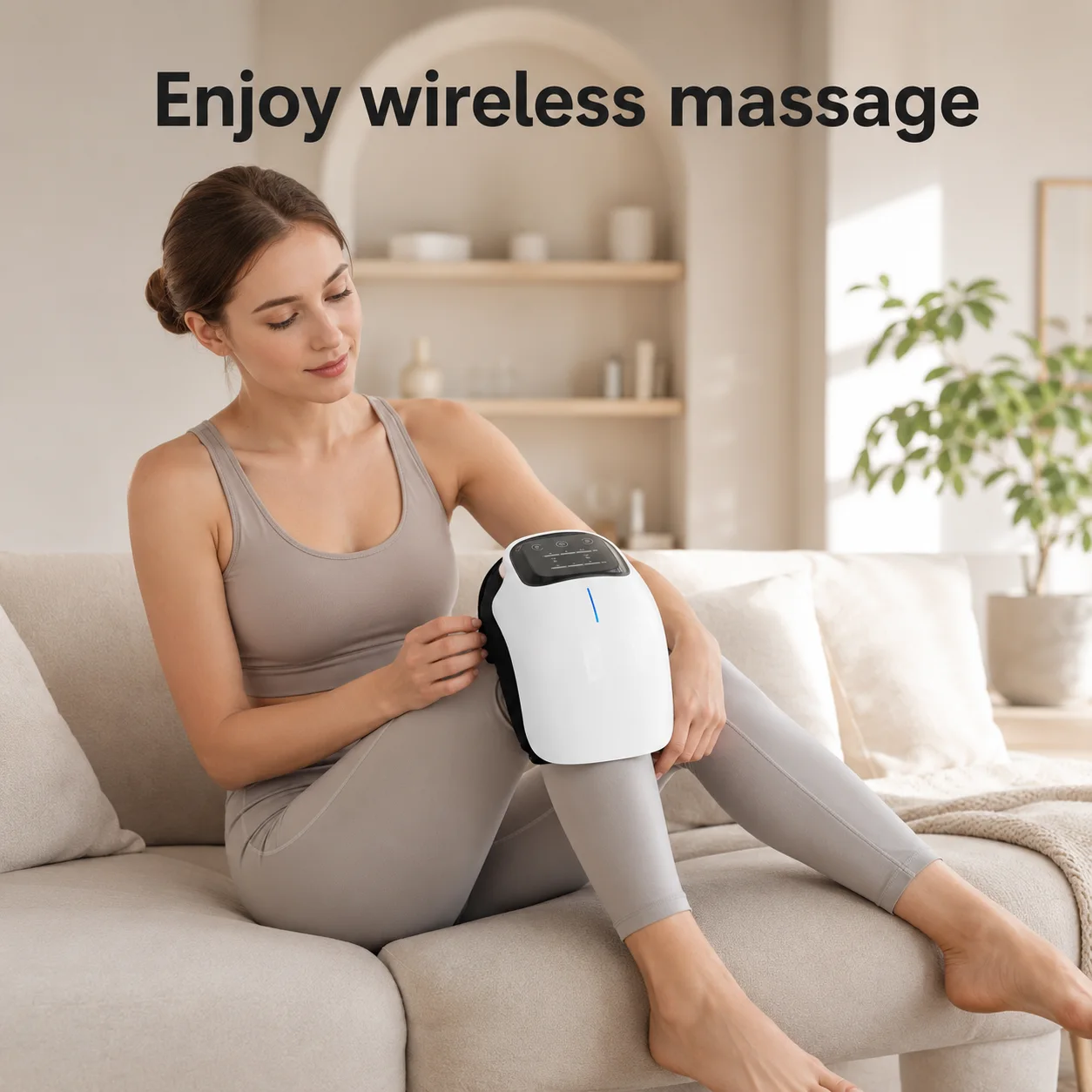
A lot of people notice it in the same order. The climb up is unremarkable. Then they turn at the top, put a foot out over the first step down, and something at the front of the knee objects. It is one of the most recognisable patterns in knee discomfort, and one of the most misexplained.
This guide sets out what has been measured about descending stairs and where the line sits that hands the question to a clinician. Dana Whitfield, who writes these guides, is a product tester and not a doctor, so nothing here is a diagnosis of your knee.
Why the way down is a different job for the muscles
Climbing and descending look like the same staircase performed backwards. Mechanically they are opposite tasks. Going up, the muscles that straighten the knee shorten while pulling, and the work goes into raising you against gravity. Going down, gravity does the moving and the same muscles have to stop it happening too fast: they stay switched on while being stretched.
Physiologists have a name for that. In a 2019 review in Frontiers in Physiology, Hody and colleagues define an eccentric, or lengthening, contraction as what happens when the force applied to a muscle exceeds the force the muscle is momentarily producing, so the muscle-tendon unit is stretched while still contracting. The same review reaches for the everyday example unprompted: it calls the braking role of these contractions classically illustrated by downhill running or walking down stairs, during which the eccentric work of the knee extensors is accentuated.
A 2023 stair-descent study in the International Journal of Exercise Science says the same in movement terms. Nelson and colleagues note that during stair descent, muscles perform eccentric contractions to absorb kinetic energy and prevent limb collapse, so the task is dominated by negative joint work compared with level walking. Summarising the published literature, the same paper states that the knee experiences up to three times greater joint moments during stair descent than during overground walking.
greater knee joint moments during stair descent than during overground walking, as summarised in a stair-descent study
— Nelson et al., International Journal of Exercise Science, 2023
Descending, in other words, is not a gentler version of climbing. It is a braking task, and the muscles at the front of the thigh do the braking every time your weight transfers onto the lower step.
What has actually been measured inside a knee on stairs
Most numbers quoted about knee loading come from models. A few come from instrumented implants: sensors inside a replacement joint, reporting the forces that genuinely pass through it. One such dataset was published by Bergmann and colleagues in PLOS ONE in 2014, from 8 subjects with instrumented knee implants across walking, stair climbing and six further activities. Their stair result is direct: during ascending or descending stairs, both force peaks were higher than the peaks during walking, clustered between 3,718 and 4,218 newtons against 2,848 and 3,372 newtons for level walking.
peak resultant knee force measured on stairs by instrumented implants, above the 2,848–3,372 N measured during level walking
— Bergmann et al., PLOS ONE, 2014
Read carefully, that says stairs load the knee more than level walking in both directions. It does not say descending beats ascending. That is where a lot of writing on this subject overreaches: we went looking for a primary source for the widely repeated claim that going down loads the kneecap far more heavily than going up, and did not find one we could stand behind. So that sentence is not in this guide.
What changes at the kneecap on the way down
What does differ between the two directions, in the one primary comparison we could read end to end, is not the pressure so much as the surface carrying it. Wang and colleagues, writing in BMC Musculoskeletal Disorders in 2023, built finite element models from the knees of 9 volunteers without knee disorders and compared the patellofemoral joint, which is the contact between the kneecap and the groove in the thigh bone, at the instant of peak extension moment in each direction: 60 degrees of knee flexion going up, 30 degrees coming down. Contact area between the kneecap cartilage and the trochlear cartilage measured 249.27 mm² during descent against 434.32 mm² during ascent, and the high-pressure area sat on the lateral part of the kneecap coming down, while it was scattered going up.
kneecap contact area modelled during stair descent versus stair ascent, with the high-pressure zone concentrated laterally on the way down
Their own conclusion is the careful one, and it is why the popular version of this story is wrong: there is only a small change in cartilage contact pressure between ascent and descent, because the joint adjusts the pressure by increasing the contact area. Going up spreads the load over a wider patch; coming down concentrates a similar pressure into a narrower one, off to the outer side. That is nine healthy male volunteers and a computer model, not a population, and we would rather say so.
The pattern is a clue, not a diagnosis
Stairs turn up as an aggravating activity across several different knee conditions, which is precisely why noticing it does not identify one. The American Academy of Orthopaedic Surgeons lists pain during activities that repeatedly bend the knee, such as climbing stairs, running, jumping or squatting, among the symptoms of patellofemoral pain. On its knee arthritis page, the same body writes that knee arthritis can make it hard to do many everyday activities, such as walking or climbing stairs.
Two conditions, one organisation, the same staircase — and tendon problems, past injuries and plain fatigue lengthen the list. So we will not read a stairs pattern and hand you a cause. What makes knees ache in general is covered in our guide on red light therapy for knee pain, and long-term joint discomfort in our knee massager for arthritis guide. Neither replaces someone examining your knee.
When the stairs are a reason to call someone
The AAOS patellofemoral pain page puts the routine threshold simply: if your pain persists, or it becomes more difficult to move your knee, contact your doctor for a thorough evaluation. That is a low bar on purpose.
The NHS publishes a shorter list for knee pain that should not wait: seek urgent advice if the knee is very painful, if you cannot move it or put any weight on it, if it is badly swollen or has changed shape, if it locks, gives way or painfully clicks, or if you have a very high temperature with redness or heat around the knee. Its routine threshold is to see a GP if knee pain does not improve within a few weeks.
Two of those often show up on stairs before anywhere else: a knee that gives way, and a knee that locks. Neither is something to manage at home with a comfort device.
What people change about the stairs themselves
Once the descent is the hard part, most people adapt before they decide to do anything about it. They take the handrail, lead with the same leg, go one step at a time, slow down on the last flight of the day. None of that is a treatment, and none of it is ours to hand out as a protocol; it is what people are already doing by the time they start reading about this.
Two things are documented about that adaptation. The AAOS lists minimising activities that aggravate the condition, such as climbing stairs, among nonsurgical options on its knee arthritis page. The same page says a doctor or a physical therapist can help develop an individualised exercise program that meets your needs and lifestyle. That is deliberate wording, and it stands as written: the version that fits your knee comes from a professional who has looked at it.
What is left, for the evening after the stairs, is comfort.
Where a heated wrap fits into the evening
A knee massager belongs to the part of the day that comes after the stairs: used sitting down, holding warmth, light and vibration against the joint hands-free while you stay still.
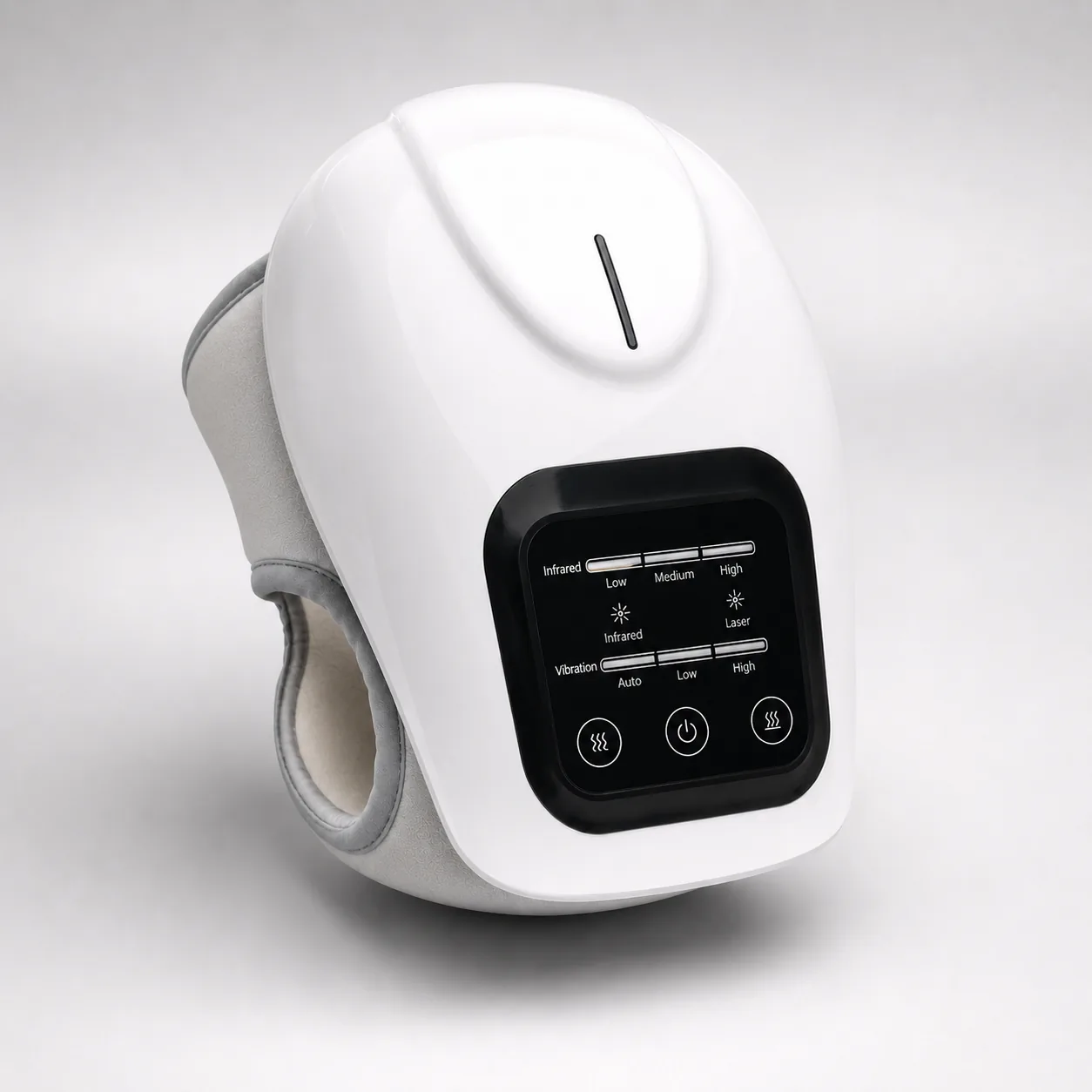
GlowKnee is built as a wrap rather than a pad. It fastens around the joint with adjustable velcro straps, so it holds its position on the front and the sides of the knee instead of needing to be held there. From the LED touchscreen on the shell you choose the heat function, LED red light, LED infrared light, and one of 3 vibration intensity levels, alone or together. It runs cordless from a 3000 mAh 3.7 V rechargeable battery; we publish the capacity rather than a runtime in hours, because we have not measured the runtime ourselves.
Verified buyers describe it in ordinary terms. One in South Korea wrote: "I bought it because my knees are a bit weak due to age. Good for kneading massage use." More of them, in their own words, are on the reviews page.
If it is the warmth you are after, the heated knee massager page covers the heat function on its own, and can you use a massager on your knee looks at what a general massage tool reaches on this joint. Before a first session, how to use a knee massager safely covers session length, skin checks and the conditions that mean asking a doctor first.
What this wrap is designed to do, and what it is not
The GlowKnee wrap is a $69.95 cordless comfort and relaxation device: heat, LED red light, LED infrared light and 3 vibration levels around the knee joint, run from a touchscreen and backed by a 30-day money-back guarantee. That is the whole of what we claim for it. It is not a medical device, and nothing in the research quoted above was carried out on this product. The light inside is LED red and infrared, not a laser, as set out on the red light therapy for knees page. If your knee has been operated on, the answer comes from your surgeon — the subject of our guide on using a knee massager after knee replacement.
Questions people ask about knee pain on the stairs
Why do stairs hurt more going down than coming up for some people?
The two directions are not the same task. Going up, the knee extensors shorten to lift you. Going down, they lengthen under load to slow you, which physiologists call an eccentric contraction. A 2023 modelling study also found the kneecap's contact area was smaller on the way down, so a similar pressure sits on less surface.
Does pain on the stairs mean I have arthritis?
We cannot tell you that, and nobody should from a distance. Stairs show up as an aggravating activity in the American Academy of Orthopaedic Surgeons' patient pages for more than one knee condition, which is exactly why the pattern alone does not name a cause. Only a clinician who can examine the joint can.
Can a knee massager be used after a day with a lot of stairs?
GlowKnee is a comfort and relaxation device, used sitting down at the end of the day rather than between flights. It applies heat, LED red and infrared light, and one of 3 vibration levels around the joint. Our guide on how to use a knee massager safely covers session length and skin checks.
Should I stop using the stairs altogether?
That is a decision for you and a clinician, not for a product page. The AAOS knee arthritis page lists minimising aggravating activities such as climbing stairs among nonsurgical options, and says a doctor or physical therapist can build an exercise program around your needs.

Dana Whitfield · Wellness Product Tester at GlowKnee
Dana has tested dozens of at-home recovery and wellness devices and writes the guides on this site. She is not a doctor or a physical therapist, and nothing here is medical advice or a substitute for a clinician who can examine your knee.
Comfort and relaxation claims only. See how we test.